
Cart
You have no items in your shopping cart
Non-stainless chromium and vanadium alloyed steel for robust work knives. Read more..
1.2235 is one of the most popular non-stainless steels for robust utility and chopping knives.
It is forgiving during forging and heat treatment and can be easily forge-welded using conventional methods.
Its applications are wide-ranging, from robust chopping and utility knives, woodworking tools, outdoor and bushcraft knives, and swords to sturdy kitchen knives. Due to its ease of processing, it is also recommended for beginners.
In Damascus steel, it has a gray appearance and can be effectively combined with a variety of other steels.
For those seeking an equally robust but more wear-resistant steel, 1.2604 is a good choice.
For bulk buyers, we also offer steel sheets in the following dimensions. Please contact us in writing or by phone if you are interested.
- 3.3 x 665 x 1120 mm
- 4.1 x 560 x 1000 mm
| Available dimensions: |
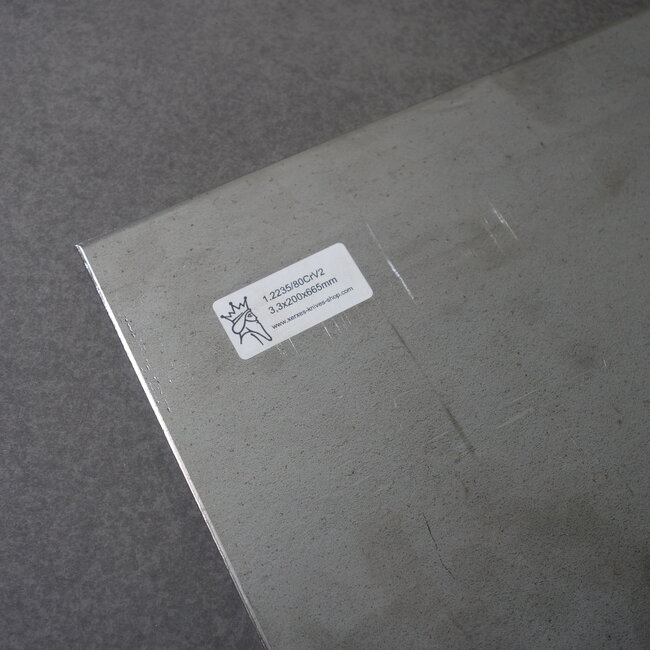
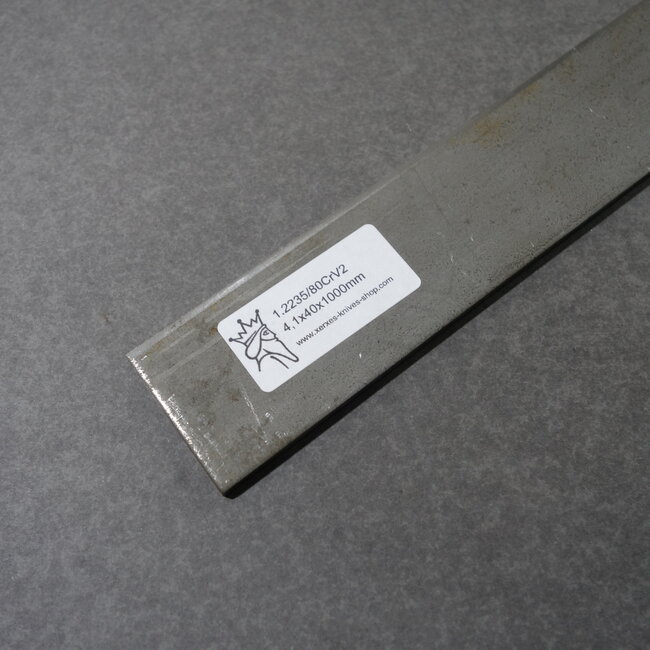
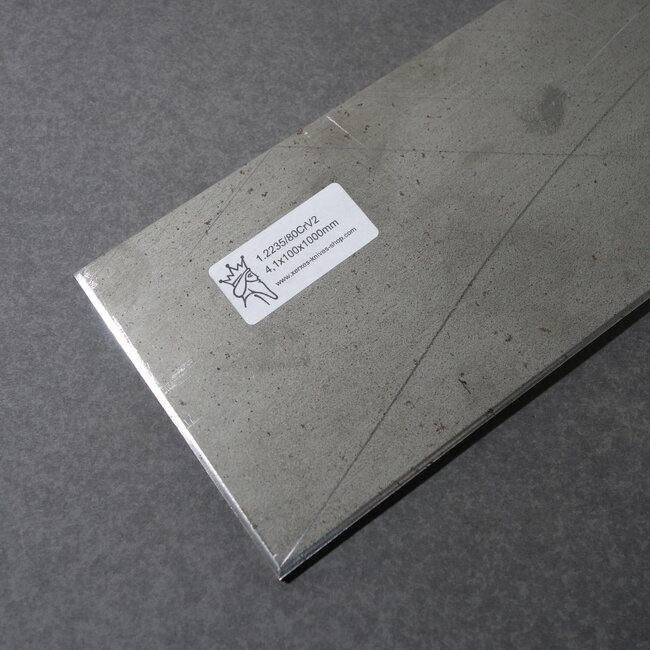
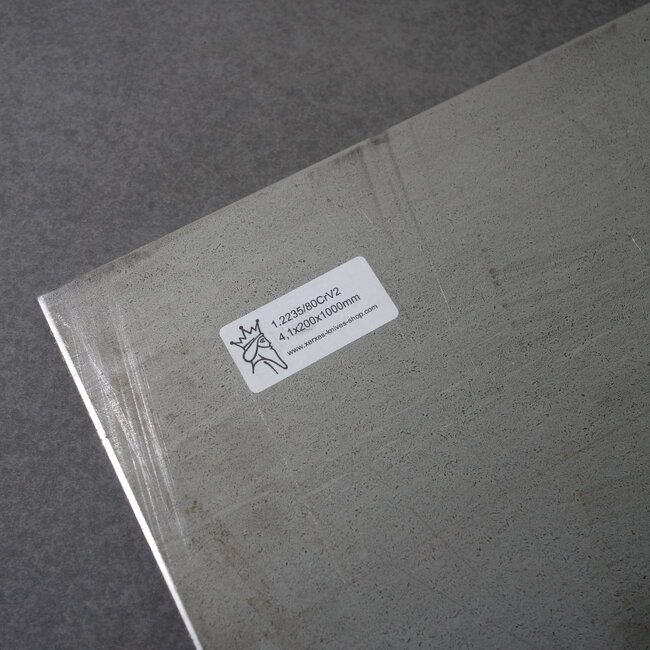
3,3x30x665mm 3,3x60x665mm 3,3x100x665mm 3,3x200x665mm 4,1x40x1000mm 4,1x60x1000mm 4,1x100x1000mm 4,1x200x1000mm |
| Composition: |
According to the factory certificate standard DIN EN 10204 - 2.2: Carbon: 0,82% Silicon: 0,327% Manganese: 0,558% Chromium: 0,53% Vanadium: 0,155% Phosphorus: 0,007% Sulfur: 0,0007% |
| Manufacturing method: |
Smelting metallurgy |
| Corrosion resistance: |
Not stainless. |
| Condition: |
Rolled, sandblasted, annealed |
| Peculiarities: |
The strips are cut with a pair of guillotines and can therefore have minimal warpage, which can, however, be easily straightened. All strips may show signs of surface rust, either partially or completely. |
| Recommended heat treatment: |
Forging: Form forging (heavy deformation) between 1100 °C and 850 °C. Fine forging (minor deformation) between 850 °C and 750 °C. Normalize: 1x Heat up to 850 °C, hold for 5 Min. and cool in air to below 721 °C (Ar1). Fine grain annealing: 2-3x heat up to 770-780 °C and immediately cool in air until the glow color has disappeared. Soft annealing: hold at 710 °C for approx. 30 minutes, then cool down in the furnace. Hardening: 820-840 °C (4-5 min holding time) Quenching: AAA-DA or Durixol V35 Tempering: 175°C to max. 200°C. (400 °C for spring rate) Achievable hardness: 59-63 hrc. Note: A deep freeze treatment (-70 °C) between hardening and tempering can reduce the retained austenite content and thus increase the working hardness with the same toughness. However, only a minor effect is to be expected with this type of steel. |